Collision and comprehensive are the two coverages that turn a basic liability policy into what most people call "full coverage." They sound similar, agents often quote them together, and lenders require both, so it is easy to assume they are interchangeable. They are not. Each covers a completely different set of risks, each carries its own deductible, and each ages differently as your vehicle gets older. Understanding the line between them helps you build a policy that actually matches your risk and your budget.
The Quick Definitions
Collision coverage pays to repair or replace your vehicle when it hits something, or something hits it. The "something" can be another car, a tree, a guardrail, a curb, a building, even a pothole that bends your wheel. Single-vehicle rollovers are also collision losses.
Comprehensive coverage, sometimes called "other-than-collision" or OTC, pays for damage to your vehicle from almost everything that is not a crash: theft, vandalism, fire, flood, hail, falling objects, animal strikes, broken windshields, and civil unrest, among others.
Both coverages are optional under state law. Your state minimum policy never includes them. However, if you finance or lease your vehicle, your lender almost always requires you to carry both until the loan is paid off.
What Collision Covers
Collision is fault-blind: it pays no matter who caused the accident, even if you are 100 percent at fault. Common covered scenarios include:
- You rear-end another driver and damage your front end.
- Another driver rear-ends you and their insurance refuses to pay or they are uninsured (you can use collision while subrogation chases the other party).
- You slide on ice into a guardrail.
- You back into a pole in a parking lot.
- You hit a deep pothole and bend a rim or break a control arm.
- Your car rolls over in a single-vehicle accident.
Collision pays up to the actual cash value (ACV) of your car, minus your deductible. If repairs would exceed roughly 70 to 80 percent of ACV, the insurer will declare the car a total loss and pay you the ACV instead.
What Comprehensive Covers
Comprehensive is the bucket for almost everything else that can damage a parked or moving car. Covered events typically include:
- Theft of the vehicle or major components like a catalytic converter.
- Vandalism, including keying, slashed tires, or smashed windows.
- Fire, whether from an electrical fault, a wildfire, or arson.
- Flood and water damage, including hurricanes and storm surge.
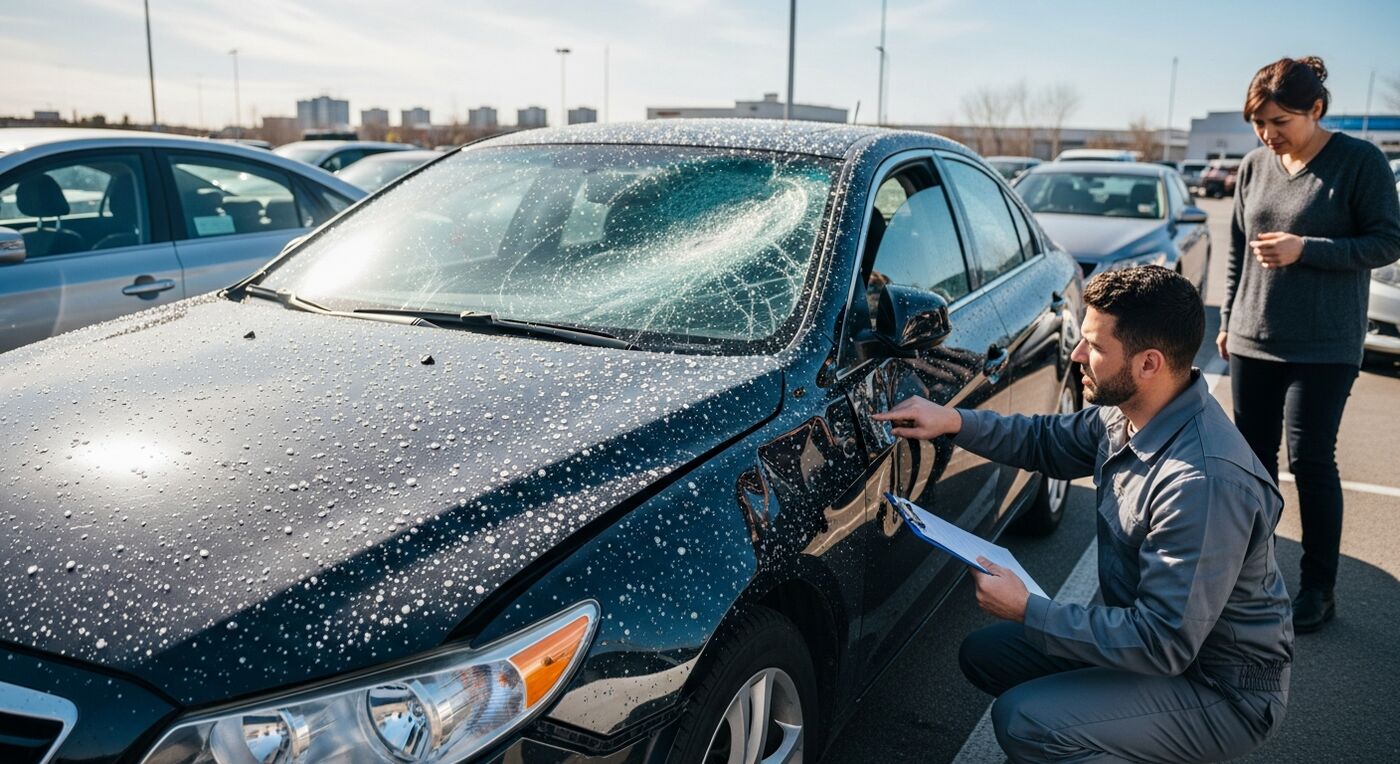
- Hail, which can total a car in minutes during a severe storm.
- Falling objects, like a tree limb or a piece of debris from a building.
- Animal strikes. Hitting a deer, moose, or large animal is comprehensive in most states, even though it feels like a collision. The reasoning is that animal strikes are unpredictable, frequent, and not the driver's fault.
- Glass breakage, including windshield cracks. Several states (Florida, Kentucky, South Carolina) require zero-deductible glass repair.
- Civil unrest, riots, and explosions.
What Neither Covers
Both coverages have important exclusions you should not assume are covered:
- Mechanical breakdown. A blown engine, failed transmission, or worn-out alternator is not a covered loss. That is what an extended warranty or mechanical breakdown insurance is for.
- Regular wear and tear. Worn brake pads, faded paint, cracked dashboards, and degraded suspension are maintenance, not insurance events.
- Intentional damage by you or anyone in your household.
- Damage during illegal activity, including racing or commission of a crime.
- Personal property inside the car. Stolen laptops, phones, and golf clubs are typically covered by your homeowners or renters policy, not auto.
- Custom parts and equipment beyond a small built-in limit (often $1,000 to $1,500), unless you purchase a specific endorsement.
Deductibles: How They Work Together
Each coverage has its own separate deductible. Common choices are $250, $500, $1,000, and $2,500. They do not have to match. A common setup:
- Collision deductible: $500 or $1,000
- Comprehensive deductible: $250 or $500
Comprehensive deductibles are often set lower because the average comprehensive claim (a windshield, a hail dent, a deer strike) is smaller than the average collision claim, and some states mandate full glass coverage. Raising your collision deductible from $500 to $1,000 typically saves 15 to 20 percent on the collision portion of your premium.
What They Cost
National average annual premiums in 2025, based on industry data:
- Collision: roughly $400 to $700 per year for a typical mid-priced sedan.
- Comprehensive: roughly $150 to $300 per year for the same vehicle.
Comprehensive is almost always cheaper because the average covered loss is smaller and many comp events (windshields, minor hail) are repairable. Collision is the bigger line item because crashes total cars at full ACV.
When to Drop One or Both
Once your car is paid off, you can legally drop collision and comprehensive. The traditional rule of thumb: when annual premium for collision plus comprehensive is more than 10 percent of your car's actual cash value, the math starts working against you.
Because comprehensive is cheaper than collision, most drivers drop collision first and keep comprehensive longer. A 14-year-old sedan worth $3,000 may not be worth $600 a year in collision coverage, but $150 a year for comprehensive still buys peace of mind against theft, hail, and falling tree limbs. A few realistic decision points:
- Car value under $4,000 to $5,000: Strongly consider dropping collision.
- Car value under $2,000: Consider dropping comprehensive too, especially if you live in a low-theft, low-weather-risk area.
- You have a fully funded emergency fund: You can self-insure smaller losses without breaking your budget.
- You park outdoors in a hail-prone, theft-prone, or wildfire-prone area: Keep comprehensive longer.
Real-World Claim Scenarios
Scenario 1: Hailstorm in Texas. Golf-ball-size hail dents your hood, roof, and trunk. Repair estimate: $6,800. You file a comprehensive claim with a $500 deductible. The insurer pays $6,300.
Scenario 2: Single-car accident. You hit a patch of black ice and slide into a tree. Damage: $9,400 on a car worth $11,000. Collision claim with a $1,000 deductible. Insurer pays $8,400.
Scenario 3: Deer strike at dusk. A deer runs in front of you and you cannot avoid it. Damage: $4,200. Comprehensive claim with $500 deductible. Insurer pays $3,700, and the claim usually does not affect your renewal rate.
Scenario 4: Catalytic converter theft. You wake up to a ruined exhaust system. Repair: $2,400. Comprehensive claim with $500 deductible. Insurer pays $1,900.
Scenario 5: Hit by an uninsured driver. Your car is hit while parked. Repair: $5,200. You can file under collision (if the at-fault party is unknown) or under uninsured motorist property damage if your state offers it. Many drivers with collision skip the UM-PD claim and just use collision.
The Bottom Line
Collision covers crashes; comprehensive covers nearly everything else. They work together to protect the value of your vehicle, but they have different price tags, different deductibles, and very different relevance as your car ages. Newer cars and financed cars almost always need both. Older paid-off cars may need only one or none. Run the math against your car's current value, your tolerance for risk, and your emergency savings, and you can stop overpaying for coverage you do not need without leaving yourself exposed to a loss you cannot absorb.
Related Articles

Liability vs. Full Coverage
Should you carry just the state minimum or pay extra for full coverage? Here is how to make the call based on your car and finances.
Understanding Auto Insurance Coverage Types
From bodily injury liability to gap insurance, this guide walks through every major coverage type and what it actually pays for.

What to Do After a Car Accident
A step-by-step guide to documenting the scene, filing a police report, and handling your claim so nothing gets denied later.